
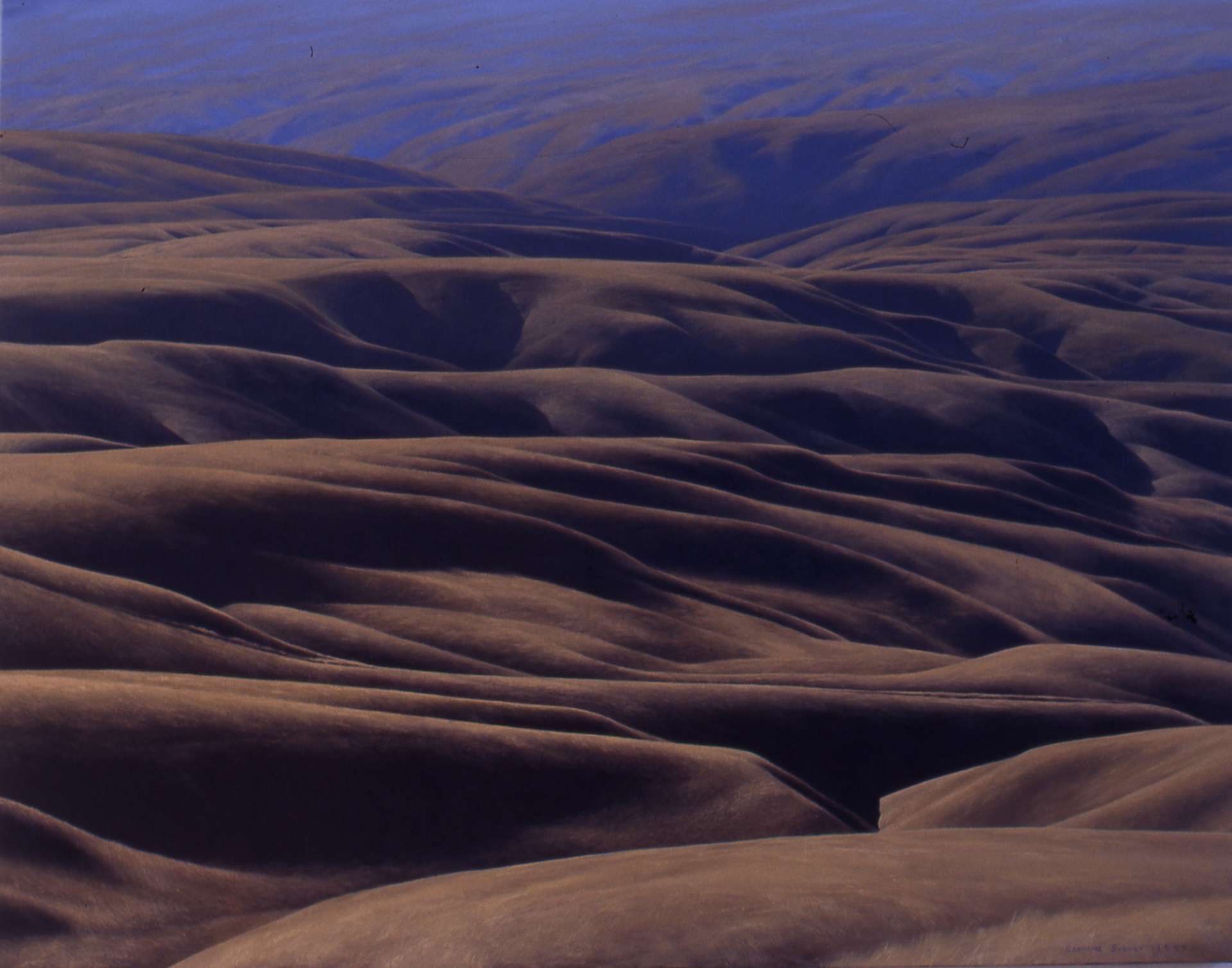
Essay on ‘Road to Onslow 1’ . Oil on Linen. 710 x 1915 mm. 1997. Private Collection. Extract from Webbs Auction Catalogue 2024. Essay by Emil McAvoy. Download PDF at bottom of page.
“Just as film makers are now making the trek into Central Otago looking for the ideal scenery for the perfect opening shot, Grahame Sydney’s painting has moved closer to cinematography. The visual language of film derives much of its potency from the seamless way in which the viewer is propelled into the imaginary world. Like the carefully composed first frames in a film, Sydney’s images with their strips of lancing road or railway track, openings in a blank facade or chunk of recognisable but anonymous landscape present us with an opening scene.” (1).
While working as a gallery assistant at the Auckland Art Gallery Toi o Tāmaki to support myself through art school, I recall Grahame Sydney speaking on the role of the imagination in his work. Sydney was presenting at an artist’s talk alongside curator Ron Brownson during his 2001 mid-career survey exhibition On the Road, at pains to emphasise that his hyper-realistic paintings were not simple translations of photographs, as they are sometimes misunderstood. Rather, they are more complicated than they may appear. During the talk, Sydney unpacked a particular painting, pointing out the subtle addition, removal and manipulation of certain details in order to create a carefully constructed composition, to the surprise of a number of audience members.
Such tensions between fact and fiction, photography and painting, real landscapes and codes of representation underpin Sydney’s work. His paintings are, on one hand, faithful depictions of the local Ōtākou environment in which he lives and works, while on the other hand they are highly staged fictions guided by longstanding landscape traditions. At one level, these physical landscapes are reimagined by the artist, and correspondingly prompt the viewer’s imagination to project itself upon them. Writing in the 2012 exhibition catalogue for Grahame Sydney: Down South, Pātaka Museum of Arts and Culture’s Senior Curator of Contemporary Art, Helen Kedgley, notes:
Sydney gives us a created world, not one that is merely recorded. While he still makes preparatory drawings, he does not paint directly from nature. He constructs his images in the studio, carefully editing and framing each view, reinventing, reducing landscape to its bare essence … Sydney’s sparse, tightly structured compositions … suggest that the scene extends far beyond the frame.
‘Road to Onslow 1’ (1997) is a prime example of Sydney’s painterly deployment of aesthetic manipulation. The scene depicts rolling hills and valleys on the road to Lake Onslow, which fade into the distance as the eye is guided through the pictorial space. The composition offers an immersive encounter, as finely rendered windswept tussock grassland in the foreground gently gives way to a hazy, impressionistic treatment of light in the distance. The atmospheric lighting presents this land as a kind of stage for potential associations and interpretations the viewer is invited to project upon it. Landscape as theatre.
Dramatic skies often dominate Sydney’s compositions, whereas ‘Road to Onslow 1’ looks down upon the earth from a distinctly elevated vantage point. While this reflects the view from the surrounding hills – the road to Lake Onslow runs along a ridge line 700 metres above sea level – a subtle ‘God’s-eye view’ is also potentially evoked. This interpretation is grounded in Sydney’s extension of Western romantic and sublime painting traditions, which portray the landscape using theatrical lighting, a pictorial code often designed to suggest a divine presence. This technique is also reflected in the visual strategies of early colonial painting in Aotearoa that attempt to Christianise the landscape, perceiving and conceiving the whenua from within this worldview. Some of Sydney’s early work engages directly with this iconography, depicting the figure of Christ and cross forms and situated in the Central Otago landscape in a more surrealist mode. In these early works, Sydney engages such aesthetic traditions, alongside the legacies of New Zealand regionalism and modernists such as Colin McCahon. ‘Road to Onslow 1’ features low-key, raking light in the foreground and middle ground, which creates deep shadows and prominent contrasts, set against a background suffused with soft, atmospheric blue light. Here, the sky appears to gently descend upon the land — ‘Godzone’ indeed.
These lighting effects, contrasted with the elevated vantage point, may produce the feeling of being at once ‘inside’ and ‘outside’ the painting. Sydney’s omission of the horizon and sky perhaps reflects the closely cropped framing of a photograph he has taken as source material. However, the painting’s composition also reinforces the sense that this is not a depiction but a representation – and in keeping, a kind of visual and conceptual abstraction.
Its honing in on a fragment drawn from a vast, wild expanse offers an attempt to contain that which it cannot. Here, Sydney extends the sublime tradition in Aotearoa through a representation of the land as rugged, spectacular and awe inspiring. A landscape that exceeds representation.
Of course, under certain atmospheric conditions and times of the day, Central Otago really does look like Sydney’s paintings. One may imagine what it must feel like to encounter such epic, sparsely populated, stark and at times unforgiving landscapes — scorching in the summer and snow-covered in winter.
Central Otago is a region the artist knows intimately, his embedded, decades-long work in this isolated environment eschewing the more conventional ‘road trip’ representations of a professional photographer or a tourist taking the scenic route. This might also go some way to explaining Sydney’s position as one of Aotearoa’s most popular and commercially successful working artists.
For some, the sense of remoteness in ‘Road to Onslow 1’ might evoke a kind of hinterland, a ‘back country’ region whose valleys were shaped by erosion caused by melting ice over immense geological time-scales. Another meaning of the term ‘hinterland’ is an area beyond what is visible or known. We may find echoes of this concept in the painting’s tight framing, which conjures a sense of the expanse beyond it. Its undulating hills might evoke folds of skin, internal landscapes or even the contours of thought.
Emil McAvoy
1 Michael Findlay, “Opening Scenes” in The Art of Grahame Sydney, (Dunedin: Longacre Press, 2000), 43.