
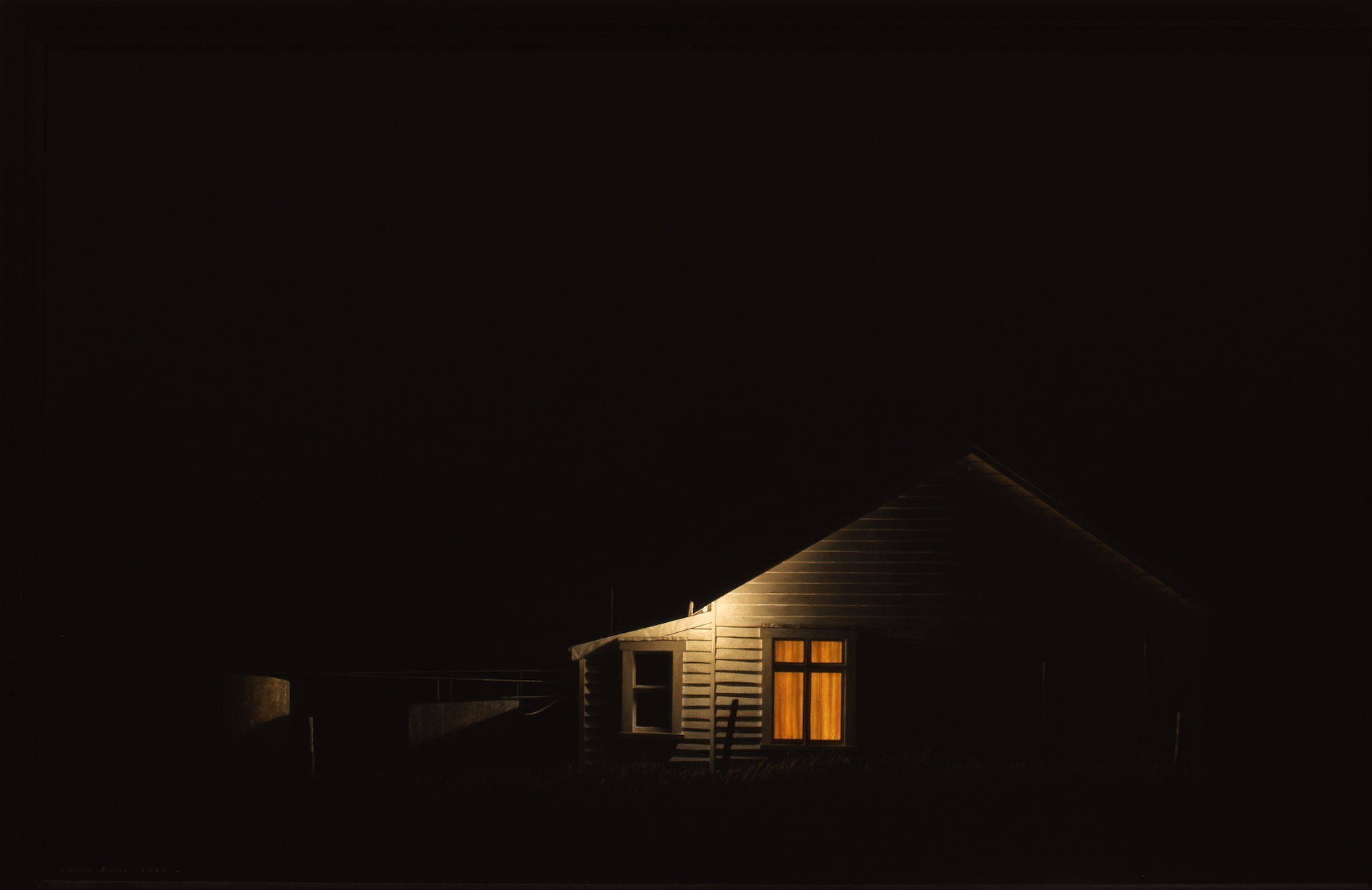
Essay on ‘Nighthouse II’. Oil on Linen. 760 x 1210 mm. 1995. Private Collection. Extract from Dunbar Sloane Auction Catalogue 2012. Download PDF at bottom of page.
The land is a shaping influence on every New Zealander’s national, collective psyche. We can measure great tracts of New Zealand through the imagery of our artists, and Grahame Sydney is no exception. One cannot help but travel through Central Otago and be reminded of his delicate portrayal of the local landscape. Yet his work is expressive of more than just the physicality of region, striking a distinctly national chord.
‘Nighthouse II’ is no exception. Sydney uniquely employs a simple motif, in this case a white weatherboard house, rather than a location of more obvious grandeur. In doing so what may appear seemingly inconsequential elements is ennobled, whilst capturing a sense of isolation inherent in such spaces. There is a reverence to formal beauty and a spiritual resonance of solitude creating a sense of calm resolution in the work an order, a truth.
However, Sydney’s work holds a far more complex narrative, an uncomfortable reality that exists in parallel to the pictorial surface. Although superficially the work appears to be a comfortable tableau of his environment, he subtly encourages the viewer to press beyond the surface. There is an uneasy, somewhat eerie relationship between nature and humanity, a sense of strangeness, tension and dislocation most obviously in the solitary structures depicted on the land, often deteriorating. The images themselves are static but the passing of time is implied. In ‘Night House II’ we see a white weatherboard house with its water tank sitting shrouded in darkness.
However, it is the light shining from within, behind drawn drapes and on the external wall of the house belying a human presence, which create an atmosphere of eerie uneasiness. Are these lights metaphors for the bravery or brevity of the human spirit? Does light denote defiance, or an assertion of the need for illumination generally? (1).
Sydney’s virtuous handling of pain produces a photographic veracity, which creates an overarching beauty, which belies the presence of the artist. When shrouded in darkness, ‘Nighthouse II’ continues to shine, illuminated apparently from within the very depths of the canvas.
It is a testament to the beauty of the work that ‘Night House II’ is not only one of the artist’s favourite works but also one of the most widely reproduced images. It is without doubt his most celebrated work to be offered on the secondary market. It stands alone as an iconic painting by one of New Zealand’s most successful and celebrated artists.
1. Grahame Sydney, The Art of Grahame Sydney (Dunedin 2000) p 102.
Dunbar Sloane 2012.