
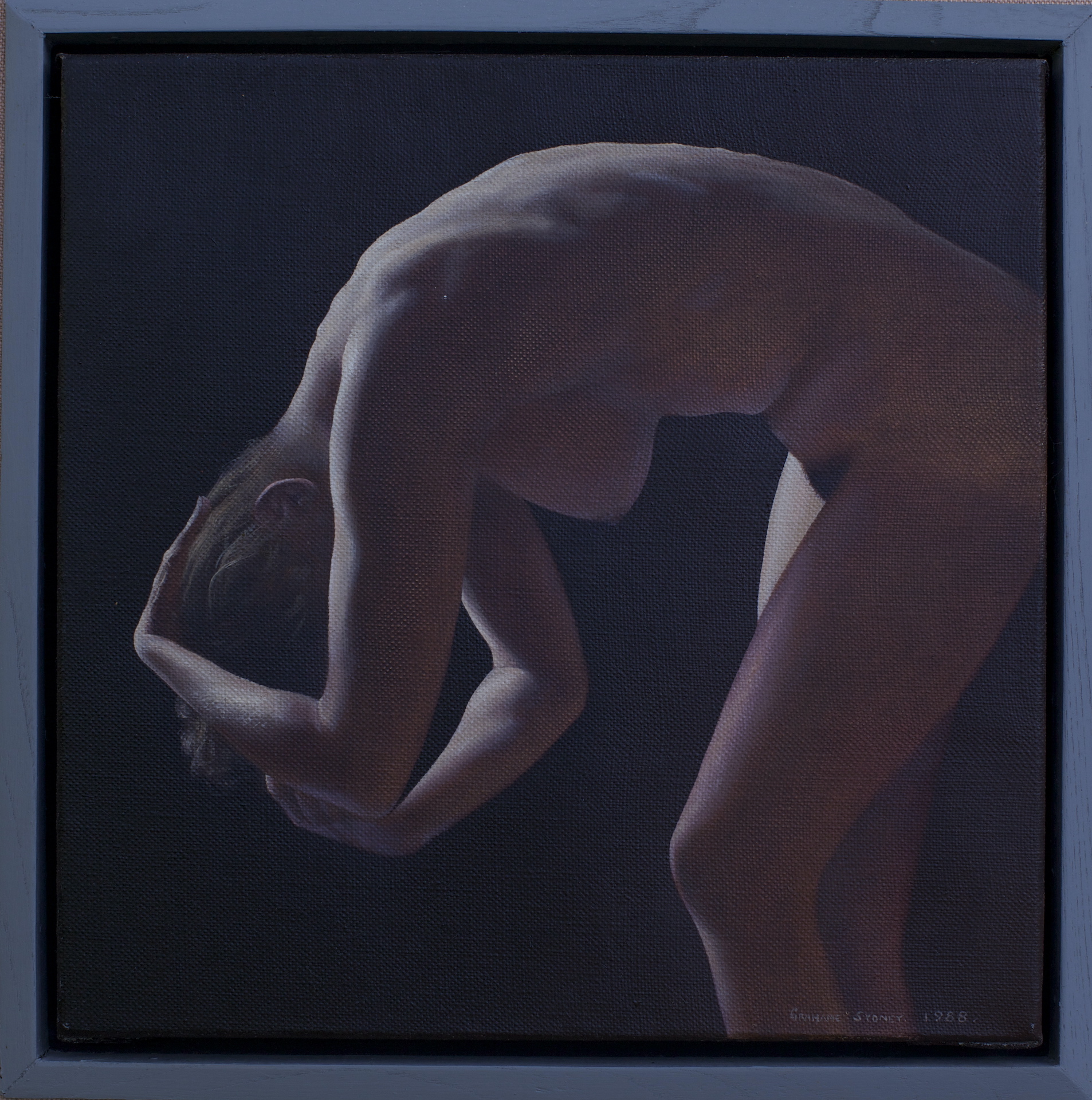
Catalogue Interview for ‘Hawkdun Moon’. Oil on Canvas. 500 x 550 mm. 2004; ‘Drying Hair’. Oil on Linen. 300 x 300mm. 1988; ‘Fats’. Oil on Panel. 600 x 350mm. 1972. Extract from Webbs Auction Catalogue 2021. Interview by Julian McKinnon. Download PDF at bottom of this page.
Grahame Sydney’s paintings are much loved and have been sought after by collectors for decades. He is particularly well known for his highly detailed renderings of the starkly beautiful Central Otago landscape. Some of his works speak simply to the power of nature in landscape; some focus on rural existence, and the human structures that exist in the vastness of the environment; yet others feature a gentler, more human touch in the form of portraiture. Altogether, Sydney’s paintings are among the most details and technically skilled by any New Zealand painter.
JMK: Hawkdun Moon (2004) addresses the central Otago landscape, as much of your work does. There’s something almost overpowering about the natural environment in this country, and your paintings capture that wonderfully. I understand that you have a view of the Hawkdun Range from where you live, so it features strongly in your day-to-day experience.
GCS: This is drawn from the terrace of my house here at Cambrian Valley, as are many of my paintings over the years. The house was built for me in 1999/2000 on a site which allows me to watch the Hawkdun Range and Mount St Bathans in their daily and seasonal changes of light and mood. Their proximity is the major reason for me building on this land. It’s an ever-changing wide-screen backdrop to our days here and I never tire of it, nor does it ever cease to be inspiring.
My landscapes have become more and more descriptors and confessions of my feelings of belonging to this Central Otago landscape, a sense I’ve recognised since my first boyhood experiences in this “foreign country” away from the damp, grey and breezy Dunedin coast where I grew up. Now the older I get the less I feel the need to travel far to find themes and subject matter – my world is getting smaller but richer, and in the last few years I’m aware my paintings are all derived from close-to-home sources. What is it which appeals so much about this empty, semi-arid inland territory? That’s not something easily put into words, far more easily revealed in the paintings.
JMK: That appeal is universal, I think. Though in some ways it’s also very personal, and paintings can also be personal things.
GCS: My paintings are first and foremost personal things, made for no-one else but me; made for my own satisfaction and pleasure with no thought whatsoever for others. The life they have beyond me is the life all paintings assume – whatever anyone wants to make of them, and is of no concern to me at all. Of course, the personal can perform a universal function, and that’s one of the miracles of art. I gifted this small oil to my friend, the wonderful historian and writer Michael King during his brave battle with cancer. I offered it as a token of appreciation and hope, and inscribed it to him accordingly. His cancer did miraculously dissolve, but soon after that thrilling news of his unexpected remission, he and his wife died in a car accident.
JMK: That was a real tragedy, and a loss for the entire country. Though even more so for those who knew him, I imagine.
GCS: I have a picture of him looking at the painting on his study wall. It’s a photograph I value very much, of a wonderful man who left a great legacy for New Zealand culture.
JMK: Looking at Fats (1972) , I wonder if it is a reflection on the passage of time. I think of the different scales of human and geological timeframes, and how human structures are fleeting.
GCS: The building here is one of the early colonial board-and-batten farm sheds built on the steep slope behind Larnach’s Castle on the Otago Peninsula, on Larnach’s original farm. It was painted during my second (and last) year of secondary school teaching, one of many works I did on the peninsula at that time. Built of timbers likely pit-sawn on the property as the colonial settlers cleared native bush from the hills, the buildings were no longer in use, unseen by most, and slowly being claimed by rot and rain. At some distant time a shearer had written his daily tallies on the exterior boards, hence the title Fats (a shearer’s term for sheep of a particular age). The numbers can be seen on the panels to the left of the window. I used to love exploring these deserted places, and I did several paintings here – most notably Downpipe (egg tempera, 1970) and Midwinter at Miss Nyhon’s (egg tempera, 1974), both works which considerably assisted my early professional career.
This painting was shown in my first ever solo show – at Moray Gallery in Dunedin in November 1972 – just before I left for London. I believe the buyer from then has kept it ever since. The show sold out, so I left for UK with my tail up, and feeling like I could paint as a way to survive. On arrival in London, I learned almost instantly that I was making a mistake. I belonged in New Zealand, particularly in the South. I used to dream of Central Otago and home.
The second lesson then was through exposure to the great galleries and great paintings. When you see them in reality, not small scale on a printed book page, you realise they’ve been done by another human, not a God. You can watch the decisions being made and that human hand at work. It transcends time and history, and is immensely inspiring – and so encouraging.
JMK: The human body in all its temporal frailty contrasts with the immutability of the land. I’m intrigued by the way these subjects interrelate – the human body being our only means of experiencing the environment. Do you see these themes as connected, or are they simply different ways of working with paint?
GCS: When my father died slowly of bone cancer in the mid-1980s I made the deliberate decision to focus at least some of my time on the long history of the female nude, hoping I could find a way to add something of my own to that noble and difficult tradition, and to emphasise the beauty I so much appreciated there. Having witnessed the sad, inexorable decline of my father’s physical state, watching that helplessly, I was – and still am – determined to make something of the natural, classical purity of that human form. Dad’s death drove me directly to a whole series of figurative paintings, because I wanted to celebrate how beautiful healthy life can be. This work was part of that series.
The challenge of finding my own way within the tradition of the nude, adding something of my own character, experience and time, continues to stimulate me today. While my figure studies are unknown to many, to me they are major challenges, matters of pride and distinction; it remains a matter of interest that in New Zealand the human form is so absent from the painted heritage.
I’m aware of the heightened sensitivity surrounding the nude in some quarters, the male gaze and other political overtones etc, but I see these images within a great tradition, working from a position of the greatest respect, and only with models who understand the process and are keen to be in the paintings. It’s a partnership, and I can’t paint anyone I don’t care about. When my wife poses for me the paintings become my permanent love letters to her, and I give those works to her as testament of my admiration – my feelings for her will live forever in the paintings. Drying Hair was posed by a wonderful model who contributed to several paintings in the later 1980s; I felt very fortunate to have her to work with.
It takes stubbornness to survive as an artist, and keeping an ear to the audience is fatal. Art comes from instinctive voices within. It’s a sad thing when painters are driven by an audience. I don’t believe in that. I work on impulse. I never take for granted that the market will be there, but that said, I care a great deal about the long run, history, and my place within it. As an artist you have to keep working, pleasing only yourself and imposing your own standards.
Last year I returned to the classical theme of the nude, and to egg tempera. I look forward immensely to far more figure studies this year and next, giving that permanent form to the simplest and most natural beauty.
Interview with Julian McKinnon.