
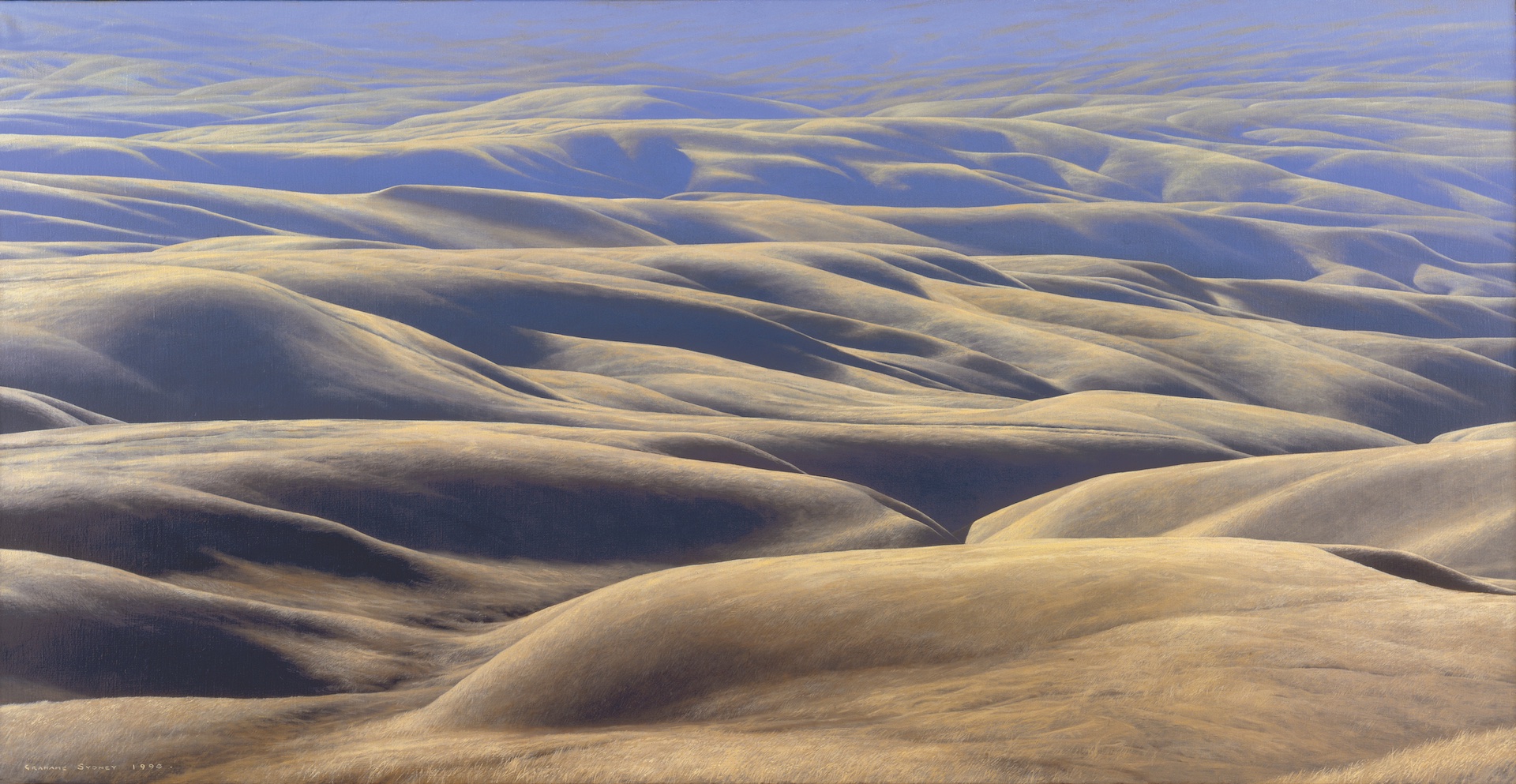
Essay on ‘Hinterland’. Oil on Linen. 710 x 1375mm. 1998. Collection of the Dunedin Public Art Gallery Collection. Extract from DPAG Quarterly Magazine March – May 2020. Essay by Carolyn Guytonbeck. Download PDF at bottom of this page.
One of my most memorable DPAG experiences was the 1999 Grahame Sydney retrospective.
I found myself surrounded by paintings that had a luminescent aura about them. It was as if there was a light behind each work, radiating the images from the walls. Crafted with rare skill, Sydney’s works in oil, watercolour, and egg tempera all glow with colour and depth. Hinterland is one of three Sydney paintings in the DPAG collection, along with several etchings and drawings. The word ‘hinterland’ refers to the remote areas of a country or an area lying beyond what is visible or known. The painting Hinterland depicts a mass of tussock covered rolling hills that softly fold in and out of each other like bunched silk. Late evening light gently lifts the curves; the shadows that create contours are black in the foreground, fading to the blue of distance as the space recedes. Our exploring eyes rove these hills and vales, simply enjoying the labyrinth space until we are quietly pulled to a valley in the distance which seemingly leads to a silent beyond.
Grahame Sydney is one of Aotearoa New Zealand’s most esteemed painters. His work is held in our major public institutions and in numerous private collections. He is particularly known for his much-loved paintings of Central Otago, an area for which he has an especial fondness. But there is an intangible quality in Sydney’s landscapes that take them beyond simple realism – and therein lies their allure. Sydney describes ’realist painting’ as simply depiction. Art, by contrast, “goes deeper than the easy skills of the trained hand. […] it revolves around the essential question of just why an artist chooses this or that manner of expression, and what it might tell us about them, and ourselves.” Writer Vincent O’Sullivan sees Sydney’s arrangements of formal aesthetic effects as “implied abstraction.”
Hinterland fits this observation well. This painting is just as much illusory form as it is an image of a landscape. In Hinterland there is no sign of the living, no greenery or nourishing water, yet one feels that these hills heave with life, as if this endless land is itself a living body. We are reminded that earth itself is a living organism over which we humans simply pass. This is a large painting reflecting the wide and open landscape that inspired it. We know such landscapes exist, yet there is a sense of the ephemeral here: while we delight in the untouched beauty, we wonder if this moment in time will last, for both ourselves and the land. Paintings such as Hinterland inspire narratives and reflections that are especially meaningful to the people of Otago.
As Vincent O’Sullivan maintains, Sydney’s paintings “begin as his, but conclude as ours.”
It is a privilege and pleasure to have such work by Sydney in the DPAG collection.
Carolyn Guytonbeck