
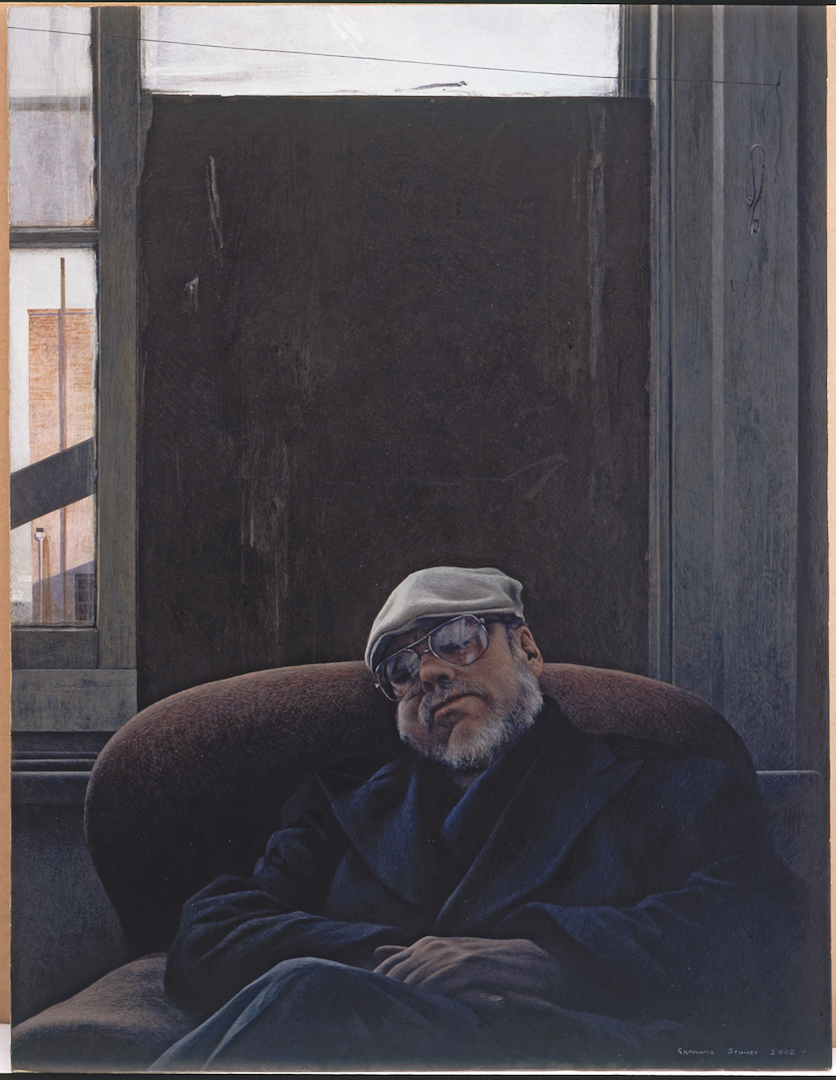
An essay on ‘Portrait of R Judkins’. Egg Tempera on Gesso. 775 x 595mm. 2002. Private Collection. An extract from ‘New Zealand Portraits’ by Richard Wolfe. Penguin Group 2008. Download PDF at bottom of this page.
Grahame Sydney’s rise to prominence as a realist painter followed a successful first exhibition in Auckland in 1975. Since then the work of the Dunedin born artist, has, according to Michael Findlay, “become, in the public mind, gradually embedded in the identity of the south”. After completing a Bachelor of Arts in English and geography is 1969 at the University of Otago Sydney attended Christchurch Teachers College and then taught in Cromwell for two years. He had painted since his early teens, and in 1973, travelled to the UK and Europe where he studied Old Masters and absorbed the ‘meticulous realism’ of Durer and the van Eycks. Other importance influences were Velasquez, John Singer Sargent, Stanley Spencer and Lucian Freud. On his return to New Zealand in 1974 he became a full time painter, choosing the old and time consuming medium of egg tempera.
Sydney’s subject was the Central Otago landscape, unpopulated but often with evidence of human presence in the form of weathered buildings and discarded elements. He also painted portraits, preferring subjects he knew well, and has only ever accepted “two or three commissions” to paint portraits of people he didn’t already know. For preparatory work he combines pencil studies and colour notes with back up photographs, and has yet to undertake a painting direct from the sitter.
In 1980 Sydney confessed he had wilfully manipulated the “facts” of landscape or interior subjects, but with his first portrait he considered such practice might be “inappropriate, if not impossible”. The expectation of a “reasonable likeness” now brought the “nuisance of accuracy” and, more significantly, “the painter’s statement about the subject”. He maintains that the ideas behind a portrait must be a “strong one”, in order for the painting to contain something which might “whisper at any passing viewer, and cause them to stop and wonder at it”.
Grahame Sydney, artist, has also been a reasonably successful triathlete, finishing the top 25 (out of a field of over 600) in the 1990 ‘Coast to Coast’ race. The race organiser, Robin Judkins, became a fried of the artist, attending exhibitions and collecting his work, and also became interested in becoming the subject of a portrait. With that agreed, Sydney did preliminary drawings at his High Street, Dunedin, studio in September 2001 and carried out the painting over a period the following year.
Sydney’s aim to capture a more intimate glimpse than Judkins’ well know public personal resulted in the sleeping figure with his ever present hat. He knew his subject as an extremely determined and active individual, but also one possessed by “the occasional demon”. For this reason Sydney included the solid rectangle behind the subject’s head, to both block the view and the light and hint at darker elements. It also served to draw the eye away from background elements towards the contrasting hat and face of the subject, set against the curved back of the armchair. By such devices Sydney is able to invest more thought and “coded information” into a painting and create a form of realism that transcends ere depiction.
The demanding egg tempera process allows for no slips of the brush: the artist is in full control of the content. Grahame Sydney regards each of his meticulous portraits as a “small defiance against Time and Mortality”. His subjects are people he admires and respects and wants to know better, and he is mindful that their portraits will outlast us and “become the focus of memories”.
Richard Wolfe.