
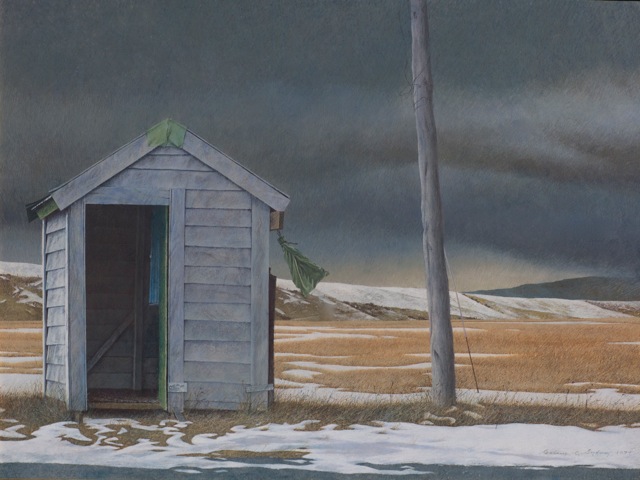
Essay on ‘2.40 Mailbag (Maniototo Plain, Naseby)’. Egg Tempera on Gesso. 440 x 600 mm. 1974. Private Collection, London. Extract from Webbs Auction Catalogue 2021. Essay by Neil Talbot. Download PDF at bottom of this page.
Grahame Sydney is one of New Zealand’s greatest living painters. His distinctive images of southern landscapes are widely admired; so to is his virtuoso skill.
His paintings are among the most detailed and technically skilled by any New Zealand painter, and he has enjoyed decades of celebrated and sought after painting output – a testament to his skill, vision, and to the vigour of the environment that has shaped his perceptions.
Views of the Central Otago landscape have been Sydney’s strongest and most recurring theme. Paintings of these southern vistas speak to the power of nature, and to the specific character of the environment that he has long called home. Restrained and tightly composed images that beautifully capture the mood, atmosphere, and play of light of New Zealand’s south is his signature style.
2.40 Mailbag is an excellent example of Sydney’s early work. Created in 1974, it shows a distinctive Central Otago landscape, meticulously painted in egg tempera. What does this painting, with its stark, empty territory reveal? Like many of Sydney’s paintings, it seems to speak to a particular dimension of the New Zealand cultural psyche – striking sombre notes of isolation, but also of desolate beauty.
In a similar vein, one can point to the gravelly tone of Owen Marshall’s literature, or the brooding disquiet of Brad McGann’s 2004 film In My Father’s Den (based on Maurice Gee’s 1972 novel of the same title).
2.40 Mailbag shows a wooden shed set against a moody sky, which is ready to spill icy rain onto a frozen tract of grassland. A small green bag is flapping in the breeze – perhaps it is the titular mailbag. A crooked post to the side reaches up, its top out of view. This device cleverly breaks the picture plane, adding a dynamic element to the painting, injecting energy and movement to the fastidiously rendered landscape. Altogether, the image effortlessly conveys the splendid isolation of New Zealand’s deep south, capturing its contemplative mood.
Sydney himself recalls this painting well. In a recent letter, he said, “The 2.40 Mailbag painting is one of the very first I did at the start of my professional career in mid-1974. I had returned from UK in May, in time for my 26th birthday, and Peter Webb had signed me up for an Auckland show within 10 days of my arriving home. I see by my tatty painting diary that it was the first one I completed during my 3-month winter stay in a little cottage in Naseby, where I went soon after the surprise visit from Peter, during which he gave me the extraordinary promise that he would buy everything I completed : ” You finish them I’ll buy them,” which he did.
With that guarantee from Peter I decided I’d better get serious and leave my home bedroom studio in Dunedin and go and be a real painter , all alone in the Central Otago heartland, which I knew was going to be my major focus (along with the Otago Peninsula). I rented a friend’s cottage in Naseby and spent three winter months there, very isolated and lonely; it was a terribly cold winter and I spent most of my time chopping wood for the coal range, when not driving around doing drawings. My brother had loaned me a car, so at least I was mobile. I drew the first studies for the Wedderburn paintings during that time, and the drawings for this 2.40 Mailbag tempera, which depicts a schoolkids’ bus shelter with the afternoon mailbag from a nearby farm slung from a hook, waiting for the rural post to collect it. A bitter day, frigid wind blowing the bag around, another snowstorm approaching.
My diary shows that I did the painting in what is known as Kettle’s Cottage, Naseby, that July, 1974.”
The work was shown in the exhibition Grahame Sydney: Paintings & Drawings held at Robert McDougall Art Gallery, Christchurch, between November 17 1976 and January 5 1977. It has not been on the market since then. Clearly prized, this painting speaks in Sydney’s distinct tongue to the unique experience of our remote and remarkable homeland.
Neil Talbot.